

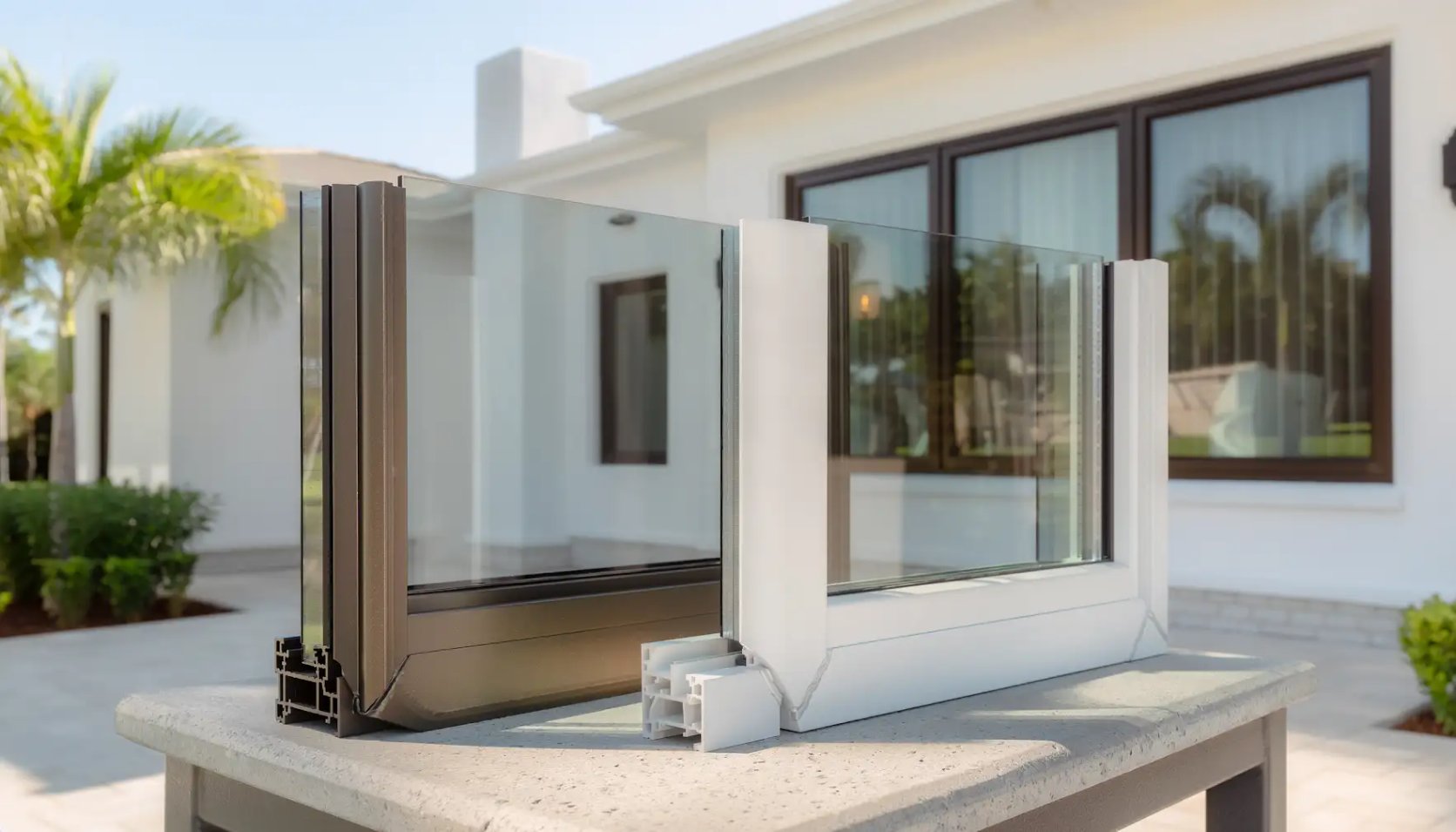
Quick Answer: Neither frame material is better everywhere. Aluminum suits large openings, slim sightlines and sliding glass doors, while vinyl resists corrosion and slows heat through the frame. What matters most is the tested system, because the design pressure rating and the HVHZ approval belong to the exact window, not the material. Plan your impact windows installation Broward County project by matching each opening to an approved product, then pick the frame that fits its size, exposure and look.
Most homeowners spend their research time on the glass. That makes sense, since the laminated glass is the part that stops flying debris. But the frame holds that glass in the wall, carries the wind load into the house, and decides how the window looks, how it handles the Florida sun, and how much care it needs through many years of salt air and summer heat. Choosing between aluminum and vinyl is one of the first real decisions when you shop for Broward County impact windows, and it is worth making on purpose.
This guide compares the two materials the way our crews see them on real homes across Coral Springs, Fort Lauderdale, Pompano Beach, Weston and Hollywood. It covers strength and frame size, design pressure and product approval, heat and expansion, coastal finish care, color and HOA review, and how the frame works with the glass and the installation. It stays on the frame decision itself and assumes you have already decided that impact windows are right for your home.
You may also see fiberglass, composite or wood-clad impact frames offered in South Florida, and the same approval rules apply to them, but aluminum and vinyl are the two materials most Broward homeowners end up choosing between.
Why the Frame Matters as Much as the Glass
An impact window is a system. The glass, the interlayer inside it, the frame, the glazing method that holds the glass in the frame, the hardware and the anchors that tie it into the wall were all tested together. If any one of those parts is weak, the whole unit is weak. A strong pane in a frame that flexes too much under wind can pull out of its pocket, and a strong frame that is poorly anchored can move in the opening.
The frame is also the part you live with every day. It sets how wide the visible border around the glass is, how the window opens and locks, what color the house shows from the street, and whether you will be rinsing salt off the finish a few times a year or barely thinking about it. Two windows with the same glass can feel very different once they are in the wall, and the frame is usually the reason.
Broward County sits inside the High-Velocity Hurricane Zone defined in the Florida Building Code, along with Miami-Dade. That means every impact window here must be an approved product for the HVHZ, and the approval covers the whole assembly. So the frame decision is never only about looks or comfort. It is about which approved systems fit your openings, and then which of those systems you prefer.
How Aluminum and Vinyl Impact Frames Are Built
Aluminum impact frames are made from extruded aluminum profiles, often with thick walls and deep glazing pockets so they can hold heavy laminated glass under high wind loads. The metal is strong and stiff for its size, which lets manufacturers keep the frame narrow while still carrying a large pane. The outside is protected by a factory finish, usually a baked paint or powder coat, and some product lines include a thermal break, which is a strip of less conductive material between the inside and outside parts of the frame.
Vinyl impact frames are made from extruded PVC with hollow chambers inside. Those chambers add stiffness and slow the movement of heat through the frame. Because vinyl alone is less stiff than aluminum, many vinyl impact products add metal reinforcement inside certain chambers, especially in larger sizes and in the meeting rails where two sashes come together. The color usually runs through the material or is applied as a factory finish.
In both cases, the frame you buy is only one part of the approved system. A vinyl frame and an aluminum frame from two different product lines can each meet HVHZ requirements, and each can also come in versions that do not. That is why the material choice and the approval check always happen together.
Strength and Frame Profile for Large Openings
For large openings, aluminum usually has the advantage. Its stiffness lets a frame span wider and taller openings with a slimmer profile, so you see more glass and less frame. That matters on the big rear walls many Broward homes have facing the pool or the yard, and on tall windows in two-story living rooms. When a homeowner wants a wide, clean view, aluminum is often the material that makes the size possible within an approved system.
Vinyl can handle many standard sizes very well, and for typical bedroom, kitchen and bathroom windows it is a common and sensible choice. As openings get larger, vinyl frames tend to get wider and deeper to carry the load, and the approved size range for a given vinyl product line may stop before the size you need. A wider frame is not a flaw, but it changes the look and the amount of glass you see.
The practical way to decide is opening by opening. A contractor measures each opening, notes its exposure, and checks which approved products in each material cover that size at the design pressure the opening needs. Some homes end up with one material throughout, and some use aluminum for the large doors and picture windows and vinyl for the smaller openings, as long as the look works together.
Sliding Glass Doors and Wide Picture Windows
Sliding glass doors are often the largest and most exposed openings in a Broward home, and they carry some of the highest wind loads on the house. Aluminum is very common here because its strength supports tall, heavy laminated panels and long tracks without a bulky frame. Vinyl sliding doors exist in impact versions too, and they can suit smaller door openings well. For wide picture windows and multi-panel doors, ask to see the approved size limits for both materials before you settle on a style, so the design you like is actually available at your opening size.
Design Pressure Ratings Belong to the Tested Product
A design pressure rating, often shown as DP, tells you how much wind pressure a window or door was tested to handle, both pushing in and pulling out. It is easy to assume that one material always rates higher than the other, but that is not how it works. The rating belongs to the specific tested product, in a specific size and configuration, with its own glass, glazing method, reinforcement and anchors. A well-built vinyl window can carry a higher rating than a lighter aluminum one, and the reverse is just as possible.
The pressure your home needs depends on where each opening sits. Height on the wall, the corners of the house, the exposure to open water or open fields, and the size of the opening all change the load. A corner window on a second floor in Hollywood near the Intracoastal can face a very different demand than a small, sheltered window on a single-story home in Coral Springs. The goal is to match each opening with a product that is rated for that opening, not to buy one number for the whole house.
When you compare quotes, look past the material and ask for the rating of each specific product at the actual size being ordered. Approved ratings often drop as a window gets larger, so a product that rates well at one size may rate lower at the size you need. That detail matters more than the word aluminum or vinyl on the proposal.
Matching HVHZ Approval to the Exact System
In the HVHZ, every window and door must carry a product approval that covers the High-Velocity Hurricane Zone. You will hear this described as a Miami-Dade County Notice of Acceptance, or NOA, issued through Miami-Dade County product control, or as a Florida Product Approval listing that covers HVHZ use. Both point to the same idea, which is that the exact assembly was tested and approved for this zone. That holds for all hurricane impact windows in Broward County, whatever the frame is made of.
You can look up approvals through the Florida Building Commission product approval search, and a good contractor will give you the approval number and documents for each product without being asked. The approval documents also include the installation drawings, which spell out the anchors, spacing and conditions the product was tested with. That ties the frame choice directly to how the window must be installed, which we cover further below.
Heat Gain, Thermal Breaks and Expansion in the Sun
Aluminum conducts heat well, so a plain aluminum frame lets more heat pass between outside and inside than a vinyl frame does. On a west-facing wall in a Broward afternoon, you can feel that difference on the inside of the frame. Aluminum product lines that include a thermal break reduce that flow by separating the outer and inner metal with a less conductive material. If heat through the frame matters to you, ask whether each aluminum product you are quoted has a thermal break.
Vinyl conducts heat much more slowly, and its hollow chambers add more resistance, so vinyl frames generally keep the inside of the frame closer to room temperature. That said, the glass makes up most of a window, so the glass package, including any low-emissivity coating and tint, usually affects comfort more than the frame does.
Heat also makes materials move. Vinyl expands and contracts more than aluminum as it heats and cools, and a dark vinyl frame in full sun gets hotter than a light one. Manufacturers design for this movement, which is one reason vinyl impact products are often offered in white and lighter colors, and why the color options for vinyl can be narrower. Aluminum moves less with heat, which helps it hold tight tolerances on large frames, although the sealant joints around any window still need to handle some movement over the years.
Salt Air and Coastal Finish Care
Distance from the ocean changes how a frame ages. Homes east of Federal Highway in Fort Lauderdale, Pompano Beach or Hollywood see far more salt in the air than homes in Parkland or Weston, and that salt settles on every exterior surface. Vinyl does not corrode, which is a real advantage near the water. Its weak points are the metal parts attached to it, such as hinges, locks, rollers and fasteners, so ask what those parts are made of and how they are protected.
Aluminum forms its own thin protective layer, and a good factory finish adds a strong barrier on top of it. The risk comes when the finish is scratched, chipped or cut, because salt and moisture can then attack the exposed metal and cause pitting or finish failure that spreads under the paint. Near the coast, a high-performance finish and careful handling during installation matter more than they do inland. If you are weighing the same question for a roof, our guide to choosing between aluminum and steel for a metal roof covers how aluminum behaves in salt air from the roofing side.
Care is simple for both materials. Rinse frames, tracks and hardware with fresh water from time to time, more often for homes close to the beach, and keep weep holes and sliding door tracks clear so water can drain. Check the finish for chips and ask the manufacturer or installer how to touch them up. Read the product warranty for any coastal terms, since some finishes and hardware carry different conditions for homes close to salt water.
Color, Appearance and HOA Review
Appearance is where many homeowners make up their minds. Aluminum frames are available in a wide range of factory colors, including bronze, black and gray tones that suit modern and Mediterranean homes, and their slim profiles keep the look clean. Vinyl frames are most often white or light tones, with some product lines offering darker exteriors or wood-look finishes. The narrower color range for vinyl comes partly from the heat movement described above.
Frame width shapes the look as much as color. On the same opening, an aluminum frame usually shows a thinner border than a vinyl one, which can matter on a home with many windows facing the street. Stand back from a sample or a finished install before you choose, because a few inches of frame repeated across a front wall changes how the house reads from the curb.
Many Broward neighborhoods, including much of Coral Springs, Parkland and Weston, have HOA architectural rules that cover frame color, glass tint and window style. Some communities limit frame colors to a short approved list or ask that new windows match the existing ones. Check your HOA rules before you fall in love with a frame, and allow time for the review so it does not hold up the rest of the project.
How the Frame Works With the Glass and the Installation
Impact glass is laminated, which means two or more layers of glass bonded to a tough interlayer. When debris strikes it, the glass can crack while the interlayer holds the pieces together and keeps the opening closed. That only works if the frame keeps holding the glass after it cracks. The glazing method, often a structural sealant or a deep glazing bead, connects the laminated glass to the frame, and that connection is part of what was tested for the approval.
This is why you cannot mix and match parts. The glass thickness, the interlayer, the glazing method and the frame material in an approved product were tested as one unit. Swapping the glass for a different type, or changing the frame color to one the approval does not cover, can take the product outside its approval. Your contractor should order exactly what the approval lists.
Anchoring, Bucks and Sealing
The frame carries the wind load into the wall through anchors, and the approval drawings set the anchor type, size, spacing and the material they go into. Most Broward homes have concrete block walls, and many openings use a wood or concrete buck, which is a frame built into the opening that the window attaches to. The condition of that buck matters a great deal. A rotted or undersized buck can undo the strength of a well-rated window, no matter which frame material sits in it.
Sealing finishes the job. The gap between the frame and the opening is sealed to keep water and air out, and the outside is often finished with stucco patching and caulk. Vinyl and aluminum frames each have their own sealing details because they move differently with heat. A good installer follows the manufacturer’s details for the material in hand, and the building department inspects the work before it is covered.
One practitioner note from our crews. On older Broward homes, especially near the coast in Fort Lauderdale and Pompano Beach, we often find that the real problem around an old window was never the frame material. It was water getting behind the old frame for years and softening the buck, or a gap that was filled with caulk instead of being flashed and sealed properly. When that is found, the repair to the opening comes first, and the new window, aluminum or vinyl, goes into a sound, dry opening.
Maintenance Over the Years and a Side by Side View
Over the long run, both materials ask for modest care. Aluminum asks you to watch the finish, rinse off salt and touch up chips before they spread. Vinyl asks you to keep it clean, watch the metal hardware and keep dark colors out of extreme heat where the product line warns against it. Both ask you to keep tracks and weep holes clear, check the exterior sealant joints for cracks, and have a professional look at any window that starts to stick, leak or rattle.
The table below lays out the main differences side by side. Treat it as a starting point for the conversation with your contractor, because the approved product for each opening still decides the final choice.
Factor | Aluminum frames | Vinyl frames |
Large openings and sliding doors | Stiff and strong, so it spans wide and tall openings with a slim profile | Suits standard sizes well, frames get wider and approved sizes may stop sooner on big openings |
Design pressure and approval | Rating belongs to the tested product and size, so check each approval | Rating belongs to the tested product and size, so check each approval |
Heat through the frame | Conducts heat, so look for a thermal break on hot exposures | Slows heat through hollow chambers, glass still matters most |
Expansion in the sun | Moves less with heat, holds tight tolerances on large frames | Moves more with heat, which is one reason darker colors are limited |
Salt air and coastal care | Finish protects the metal, rinse salt and touch up chips | Frame does not corrode, but hardware and fasteners still need care |
Color and appearance | Wide factory color range and thinner sightlines | Mostly white and light tones, often a wider frame border |
If you are still deciding whether your current windows have reached the point of replacement, our article on the signs your Broward County home needs new impact windows walks through what to look for first. Once you know you are replacing, the frame choice in this guide is the next step.
A Simple Frame Selection Checklist
Use this short list to keep the frame decision organized before you sign a proposal. It works whether you are replacing two windows or comparing quotes for every opening in the house.
• List every opening with its approximate size, floor level and the direction it faces.
• Ask which approved products in aluminum and in vinyl cover each opening at its size and required design pressure.
• Get the approval number and installation drawings for every product on the proposal.
• For aluminum on hot exposures, confirm whether the product line includes a thermal break.
• For vinyl, confirm the hardware materials and any color limits tied to heat.
• For homes near the coast, ask about finish type, hardware protection and any coastal warranty terms.
• Check your HOA rules for frame color, glass tint and style before you choose.
• Confirm who inspects and repairs the bucks and openings once the old windows come out.
Ready to compare aluminum and vinyl for your own openings? All America Construction Services can measure each window and door, show you the approved options in both materials, and explain how each would look and perform on your home. Call (954) 225-6087 to book a free in-home assessment, or learn more about our impact window installation for Broward County homes before we visit.
Frequently Asked Questions
Are aluminum impact windows stronger than vinyl impact windows?
Aluminum is the stiffer material, so it can span larger openings with a slimmer frame. But the strength that counts for your home is the tested design pressure of the specific product at its size. A well-built vinyl window can carry a higher rating than a lighter aluminum one. Compare the approved rating for each product rather than the material name.
Do vinyl impact windows hold up in South Florida heat?
Yes, vinyl impact windows are designed for hot climates and are widely used across Broward. Vinyl does expand more than aluminum as it heats, which is why many product lines favor white and lighter colors. Follow the manufacturer’s color guidance for sunny exposures. Keep the sealant joints around the frame in good condition so the movement does not open gaps.
Which frame material is better for a home near the beach?
Vinyl does not corrode, which is a real plus near salt water, but its metal hardware still needs attention. Aluminum can perform well near the coast when it has a high-performance finish and the finish is kept free of chips. For either material, rinse salt off regularly and keep tracks and weep holes clear. Read the warranty for any terms tied to distance from the coast.
Can I mix aluminum and vinyl windows on the same house?
Many homes do, often with aluminum on large sliding doors and picture windows and vinyl on smaller openings. Each product just needs its own approval for the HVHZ and the right rating for its opening. The main concern is appearance, so match colors and frame widths as closely as you can. Check your HOA rules too, since some communities ask for a consistent look.
What is a thermal break in an aluminum window frame?
A thermal break is a strip of less conductive material placed between the outer and inner parts of an aluminum frame. It slows the flow of heat through the metal, so the inside of the frame stays cooler on hot days. Not every aluminum impact product includes one. If heat through the frame matters to you, ask about it for each product you are quoted.
How do I know an impact window is approved for Broward County?
Broward is in the High-Velocity Hurricane Zone, so each product needs an approval that covers HVHZ use. That is usually shown as a Miami-Dade Notice of Acceptance or a Florida Product Approval listing for the HVHZ. You can search approvals through the Florida Building Commission, and your contractor should hand you the documents. Check that the approved sizes and ratings match the windows on your proposal.
Does the frame material change how the window is installed?
The basic steps are similar, but the approval drawings for each product set the anchors, spacing and sealing details. Aluminum and vinyl move differently with heat, so their sealing details can differ. The condition of the wood or concrete buck around the opening matters for both. The building department inspects the installation before the opening is finished.