

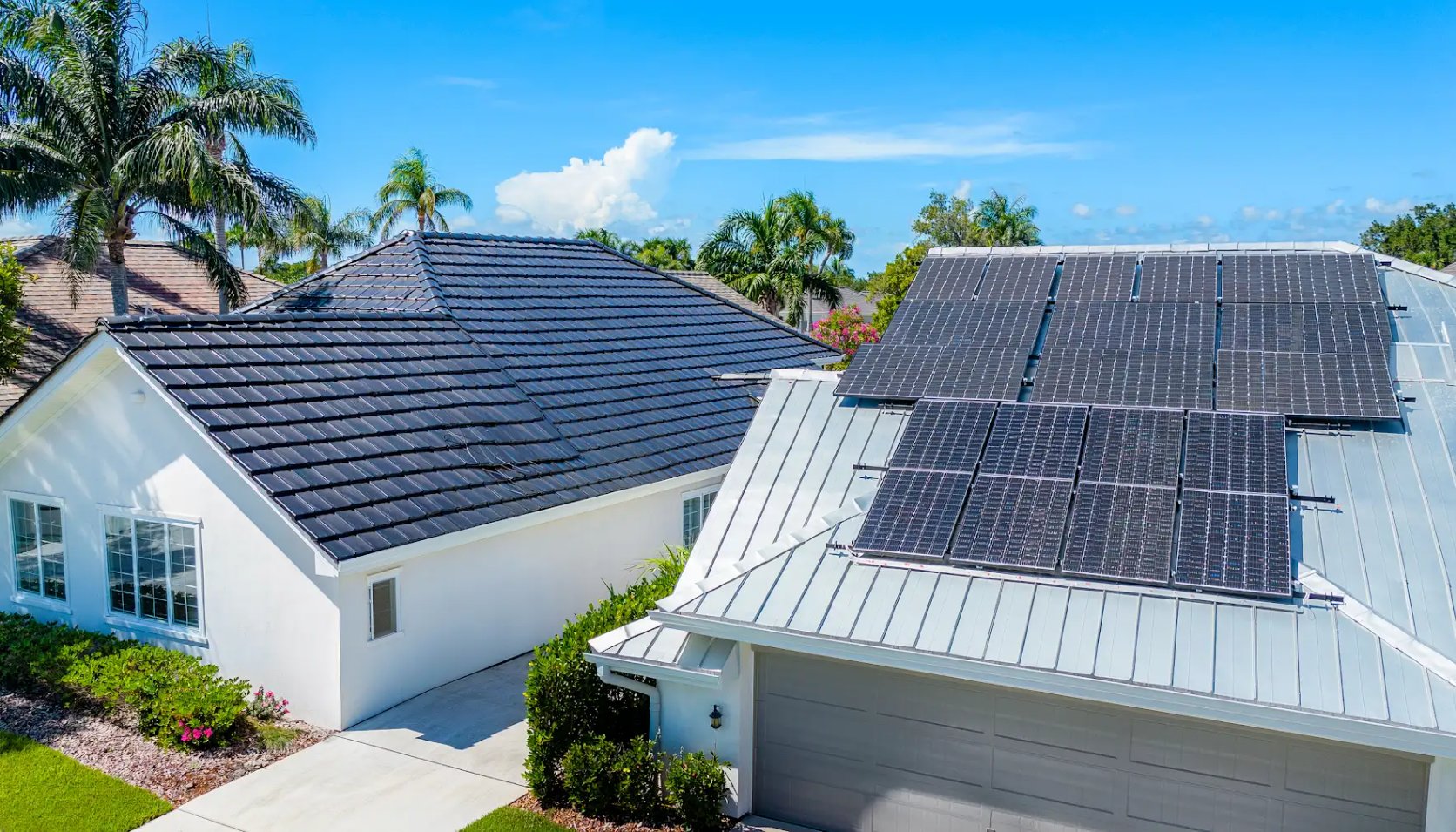
Quick Answer: If your roof is due for replacement and you want solar, you have two main paths. An integrated solar roof builds the solar into the roofing itself, while a new conventional roof with rack-mounted panels keeps the two separate. Choosing the solar roof Florida sun and storms will test for decades comes down to your roof type, the look you want, how much of the roof gets good sun, wind approvals and future roof work.
A roof replacement is one of the few moments when a homeowner can choose how solar fits into the house from the ground up. Once the old roof is off, nothing is in the way. You can make the solar part of the roof, or you can put down a new roof and mount panels above it. Both paths can give a South Florida home clean power for many years, but they are built differently, they look different and they behave differently when the roof needs work later.
At All America Construction Services, we handle both roofing and solar for homes across Broward, Miami-Dade and Palm Beach counties, and we have been doing roofing work in South Florida since 2018. That gives us a clear view of how each option plays out on real homes, from tile roofs in Coral Springs to shingle roofs in Delray Beach and metal roofs closer to the coast.
This guide compares the two paths on the points that matter most when the roof is being replaced anyway. It does not quote prices or savings, because those depend on your home and your design. It is meant to help you walk into an estimate knowing which questions will decide the right choice for your roof.
Why a Roof Replacement Is the Right Time to Decide
Timing is the first reason to think about solar now rather than later. The U.S. Department of Energy points out in its article on adding solar when you replace your roof that doing both at the same time means you avoid having solar panels taken off and put back after a future roof replacement. When the roof and the solar are planned together, the roof under the solar starts its life at the same time as the system on top of it.
The second reason is design freedom. With the old roof gone, the contractor can plan the deck repairs, the underlayment, the roof covering and the solar layout as one project. Mounts can be placed where the framing is strongest. Wiring routes can be planned before the roof is closed up. If you choose an integrated system, the solar can be laid out as part of the roof itself instead of being fitted around an existing covering.
If your current roof still has many good years left, the decision looks different, and our guide on adding solar panels to an older roof covers that situation. This article is for the homeowner whose roof is due now and who wants to get both decisions right at once.
How Each Option Is Built and Attached
The biggest difference between the two paths is where the solar sits in relation to the roof. An integrated solar roof puts the solar in the roof plane. Rack-mounted panels sit above a finished roof on a frame that is fastened down through it. That one difference drives most of the trade-offs that follow.
How an Integrated Solar Roof Goes On
With an integrated solar roof, solar tiles, shingles or laminated solar sections are installed as part of the roof covering. They sit roughly flush with the rest of the roof and are fastened in a similar way to the roofing around them. Matching non-solar pieces cover the parts of the roof that do not produce power, so the finished roof reads as one surface. The solar pieces and the roofing pieces work together to shed water, which means installation detail matters on every course.
How Panels Mount on a New Roof
With a new roof plus panels, the roofer installs a complete, watertight roof first. The solar crew then fastens mounting points to the roof framing, sets rails on those mounts and clamps the panels to the rails. The panels sit a few inches above the roof surface, which lets air move underneath them. Each mount has to be sealed and flashed into the new roof covering so water cannot follow the fastener into the deck.
Neither method is better in every case. An integrated roof has fewer separate parts sitting above the roof. A racked system keeps the roof and the solar as two independent layers, which can make each one easier to work on later. The right choice depends on the rest of the factors below.
Which Roof Types Suit Each Option
The roof covering you want plays a big part in this decision. South Florida homes commonly have concrete or clay tile, asphalt shingle or metal roofs, and each one pairs differently with the two solar paths.
Tile roofs are popular across Broward and Miami-Dade for their look and their long life. Mounting panels on tile takes special attachments and careful work around the tiles at every mount, because tile breaks easily if it is walked on or drilled the wrong way. Integrated solar products made to sit alongside tile-style roofing avoid the racks entirely, which some homeowners prefer for the look. On a tile roof, ask the contractor exactly how each option is attached and how tiles around the solar are protected.
Shingle roofs are the most straightforward base for rack-mounted panels, and there are also integrated solar products designed to sit alongside shingles. Metal roofs, especially standing seam, can often carry panels on clamps that grip the raised seams, which reduces the number of holes in the roof. If you are replacing a roof and have your heart set on a particular roof covering, start by asking which solar options are approved to work with it in your county.
Location matters too. Homes near the coast in places like Hollywood or Pompano Beach face salt air that is hard on exposed metal parts. With panels, ask what the rails, clamps and fasteners are made of and how they hold up near salt water. With an integrated roof, ask how the edges, flashings and fasteners are protected. On any roof type, the condition of the deck and framing also needs checking once the old roof is off, because both solar paths depend on a sound structure underneath.
How Much of the Roof Can Produce Power
Whichever path you choose, not every part of the roof will produce power. Solar works best on planes that face the sun for long parts of the day and stay clear of shade from trees, palms and nearby buildings. A roof with long, open planes gives more room for solar than one broken up by hips, valleys, dormers and vents.
With an integrated roof, the solar pieces go on the best planes and matching non-solar pieces cover the rest, so the whole roof looks the same even though only part of it produces power. With panels, the array covers the best planes and the rest of the roof is simply the new roof covering. In both cases, a good designer studies your roof plane by plane and shows you the layout on a drawing of your home.
Ask how the layout changes if you plan to add a battery or expect your power use to grow, for example with an electric vehicle or a pool pump. Some designs leave room to add more later, and some do not. Knowing that up front helps you choose a system that still fits your household in years to come.
The electrical side is much the same for both paths. The power from the roof runs to inverters and then into your main electrical panel, and many older South Florida homes have panels that were never sized with solar in mind. Ask early whether your panel can take the new system as it stands, where any battery equipment would go and which circuits would stay on during an outage. Getting those answers before the design is final keeps a panel upgrade from showing up late in the project.
Appearance and HOA Review
For many homeowners, the look of the finished roof is the deciding factor. An integrated solar roof is designed to look like one roof from the street, with no visible rails or gaps. Panels are easy to spot, though a well-planned array with tidy edges and hidden wiring can look neat on a new roof. Visit homes with each type if you can, and look at them from the street at different times of day.
If you live in a community with an HOA, expect a review either way. Panels may need drawings showing their location, while an integrated roof changes the color and texture of the whole roof, so the board may ask for product samples or photos. Start that conversation early and give the board a complete package. A clear submission the first time keeps the review from holding up permits and ordering.
Think about style choices as well. Conventional roofing comes in a wide range of tile profiles, shingle colors and metal finishes, while integrated solar products may offer fewer color and style options. If a particular roof look matters to you or your board, ask to see what each path can offer before you settle on one.
Storm and Wind Considerations in the HVHZ
Broward and Miami-Dade counties sit inside the High-Velocity Hurricane Zone, or HVHZ, defined in the Florida Building Code. Palm Beach County is outside that zone but still follows the code’s high wind requirements. Any roof covering installed here, with or without solar, has to be approved for use in your area and attached exactly as that approval requires.
For a new roof plus panels, there are two things to confirm. The roof covering needs its own approval and attachment method, and the solar racking has to be engineered and fastened so wind cannot pull the panels or the mounts loose. For an integrated solar roof, the solar product is part of the roof covering, so it needs approval as a roofing product for the zone where your home sits. Product approvals can be looked up through the Florida Building Commission product approval system, and a contractor who works in the HVHZ should hand you the paperwork without being asked.
Storm planning also includes what happens after a hurricane. Ask how each system would be inspected after a major storm, who handles repairs to the roof and to the solar and whether those repairs need separate crews. That answer is part of the decision, not an afterthought.
Timing is part of storm planning too. Atlantic hurricane season runs from June 1 through November 30, and a roof replacement leaves the home partly open while the old roof comes off and the new layers go on. Whichever path you choose, plan the design, approvals and material orders early so the roof work can be scheduled with storm season in mind, and ask how the crew protects the home if a storm threatens mid-project.
Roof Penetrations and Leak Points
Every hole in a roof is a place where water could get in if the work is not done well. Rack-mounted panels need many attachment points through the new roof covering, each one sealed and flashed. Integrated systems avoid most of those mounts because the solar is part of the covering, but they still need careful detailing at edges, transitions and the points where wiring passes into the attic.
Both approaches can stay dry for many years when they are installed correctly. The risk comes from rushed work, the wrong flashing for the roof type, or a solar crew that is not trained on the roofing system underneath. That is why it matters who installs the roof and who installs the solar, and whether they are working from the same plan.
One practitioner note from our crews. When we inspect South Florida roofs that already carry solar, the leaks we find most often trace back to mounts that were not flashed into the roofing properly, or to tiles that were cracked during the solar install and never replaced. Neither problem is caused by solar itself. Both come from the roof and solar work being treated as separate jobs.
Maintenance and Future Roof Work
Think about the whole life of the roof, not just the install. With panels on a new roof, the roof underneath is hidden but still there. If a section of roof needs repair later, the panels above it may have to be removed and reinstalled, which adds time and another trade to the job. Starting with a brand new roof under the panels helps, because the roof and the solar begin their lives together.
With an integrated solar roof, there is no separate layer to lift, but any repair to the roof is also a repair to the solar system. That work should be done by a crew trained on that specific product, so ask who would service the roof if a section is damaged and how replacement pieces are sourced. In both cases, keep the design drawings, the product approvals and the permit records together so any future contractor knows exactly what is on your roof.
Day to day, both systems need little from the homeowner. You can watch the monitoring app for drops in output, look at the roof from the ground after storms and book a professional inspection if something looks wrong. Climbing onto the roof yourself is never needed and is not safe, especially on tile or metal.
One Contractor for Roof and Solar, and How to Decide
When the roof and the solar are handled by one contractor, one team owns the whole result. The roof design, the solar layout, the electrical work, the permits and the inspections all come from one plan. If a question comes up years later, you have one company to call instead of two companies pointing at each other. That is the biggest practical reason many homeowners look for a single team for Florida roofing and solar.
It also helps with the decision itself. A contractor who installs both integrated solar roofs and standard solar panel systems can compare the two on your actual roof rather than steering you toward the only thing they sell. If you want to see what a full integrated project involves from start to finish, our guide to planning an integrated solar roof project walks through each step.
Comparing the Two Side by Side
Most homeowners find that two or three factors settle the choice. A strong preference for a clean, single-surface look points toward an integrated roof. A tile roof you love, or a wish to keep the roof and solar as separate layers, often points toward panels. Homeowners comparing solar roofing in Miami, Hollywood or Homestead should weigh the same factors. The table below sums up how the two paths compare.
Factor | Integrated solar roof | New roof plus solar panels |
How it attaches | Solar pieces are installed as part of the roof covering | Panels sit on rails fastened through the new roof |
Appearance | Reads as one roof surface from the street | Panels are visible above the roof covering |
Roof type fit | Products are made for specific roof styles | Works on shingle, tile and metal with the right mounts |
Leak points | Fewer mounts, careful detail at edges and transitions | Many mounts, each sealed and flashed into the roof |
Wind approval | Approved as a roofing product for your zone | Roof covering and racking each need the right approval |
Future roof work | Repairs need a crew trained on that product | Panels may need removal to repair the roof below |
Bring this table to your estimate and ask the contractor to fill in the details for your home. A good proposal will answer every row clearly and show you the trade-offs on your own roof.
A Simple Solar Roof Decision Checklist
Use this checklist before your roof inspection or in-home assessment so the conversation stays on the points that will decide your project.
• Confirm that your current roof is due for replacement and note any leaks, repairs or added layers.
• Decide which roof covering you want, such as tile, shingle or metal.
• Ask which solar options are approved to work with that roof covering in your county.
• Note which parts of the roof stay shaded and whether any trees will be trimmed.
• Decide how much the look of a single roof surface matters to you and your HOA.
• Ask how each option is attached and how every penetration is sealed.
• Ask who would repair the roof and the solar after a storm or in future years.
• Confirm in writing who handles permits, inspections and the utility connection.
With these answers in hand, the choice between an integrated solar roof and a new roof with panels usually becomes clear, and you will be ready to compare proposals on the same terms.
Replacing your roof and thinking about solar? All America Construction Services installs both integrated solar roofs and new roofs with solar panels across Broward, Miami-Dade and Palm Beach counties. Call (954) 225-6087 to book a roof inspection or in-home assessment, and explore our solar roof options for South Florida homes before your visit.
Frequently Asked Questions
What is the main difference between a solar roof and solar panels?
A solar roof builds the solar into the roof covering itself, so the solar pieces and the roofing work together as one surface. Solar panels sit on rails above a finished roof and are fastened through it. Both can produce clean power, but they differ in look, attachment and how future roof repairs are handled.
Should I add solar at the same time as a roof replacement?
If you want solar and your roof is due, doing both together is usually the cleaner path. The U.S. Department of Energy notes that it avoids taking panels off and putting them back after a future roof replacement. It also lets the roof and the solar be designed as one project from the start.
Can I put solar panels on a tile roof in South Florida?
Yes, but tile needs special mounts and careful work at every attachment point because tiles crack easily. The installer has to protect the tiles around each mount and flash it properly into the roof. Some homeowners with tile roofs prefer an integrated solar product instead, so ask your contractor to compare both on your roof.
Is one option better for hurricane winds?
Both can be built for South Florida wind conditions when the products are approved for your zone and installed as that approval requires. An integrated roof is approved as a roofing product, while a panel system needs an approved roof covering plus properly engineered racking. Ask to see the approval paperwork for every part of the system.
Does a solar roof cover the whole roof with solar?
Usually not. Solar pieces go on the planes with the best sun, and matching non-solar pieces cover shaded or awkward areas. The finished roof looks like one surface even though only part of it produces power. Your designer should show you the layout on a drawing of your own roof.
Will my HOA approve a solar roof or solar panels?
Many HOAs allow solar but ask to review it first. Panels may need a location drawing, while an integrated roof may need samples or photos because it changes the look of the whole roof. Submit a complete package early so the review does not delay your permit.
Why does it matter if one contractor handles both the roof and the solar?
One contractor means one plan, one schedule and one team responsible for keeping the roof dry and the system working. Leaks around solar often come from roof and solar work being done by separate crews that are not working from the same plan. A single team also gives you one call to make if anything needs attention later.