Catastrophic commercial roof collapses are rare, but when they happen the consequences are severe enough that no building owner can afford to assume immunity. A roof that fails suddenly can damage inventory, hurt occupants, halt operations for weeks, expose the owner to liability claims, and turn what was a manageable maintenance situation into a disaster. The reassuring side of that bad news is that almost every catastrophic commercial collapse can be traced to a small list of identifiable causes, and almost all of those causes leave warning signs that a careful building owner can spot well before failure.
This article walks through what actually causes commercial roofs to collapse, what the early warning signs look like, and what genuinely prevents the conditions that lead to failure. The framing is deliberately not alarmist. The point is not to suggest your roof is about to fall down; the point is to give building owners and property managers enough specifics that they can recognise the situations that deserve immediate attention and the patterns that deserve scheduled review. A catastrophic collapse is the end stage of a process that almost always could have been interrupted earlier.
If your commercial roof shows any of the warning signs described below, do not wait for the next storm to confirm them. A prompt structural assessment from experienced roofing companies in Broward County is the right immediate step, and in South Florida that conversation is best had during calm weather rather than under emergency conditions.
What Catastrophic Collapse Actually Means in the Commercial Context
Not every roof failure is a catastrophic collapse, and confusing categories makes prevention harder. The serious version has a specific shape.
Sudden Structural Failure of a Significant Roof Area
A catastrophic collapse is the sudden structural failure of a meaningful portion of a commercial roof, where the load-bearing components themselves give way and the roof drops into the building below. This is different from a leak, different from membrane damage, and different from local material failure. It involves the structure itself, which is what makes it so dangerous and so disruptive. Collapses can be partial, affecting one section while the rest of the roof remains intact, or complete, where the failure cascades across the building. Both are serious; both warrant emergency response and full structural review before anyone is allowed back into the affected area.
The Common Pattern Behind Collapse Events
Look across collapse events and a pattern emerges. Almost none of them are caused by a single dramatic event acting on a previously perfect roof. The typical sequence involves an existing structural weakness, often hidden, that is then triggered by a load the weakened roof cannot bear. The weakness might be decades of moisture damage to wood structural members. The trigger might be a heavy rain event, a wind storm, or even the cumulative load of equipment added over the years. Recognizing that collapses are usually the meeting point of an existing weakness with a triggering load is the foundation for prevention; addressing the weakness while it is still small is what keeps the trigger from finding it.
Cause 1: Ponding Water and Roof Overloading
Water is heavier than people instinctively realise, and it is the most underestimated cause of commercial roof failures in Florida. A flat or low-slope roof that cannot drain properly can accumulate weight that the structure was never designed to bear.
The Math of Water Weight
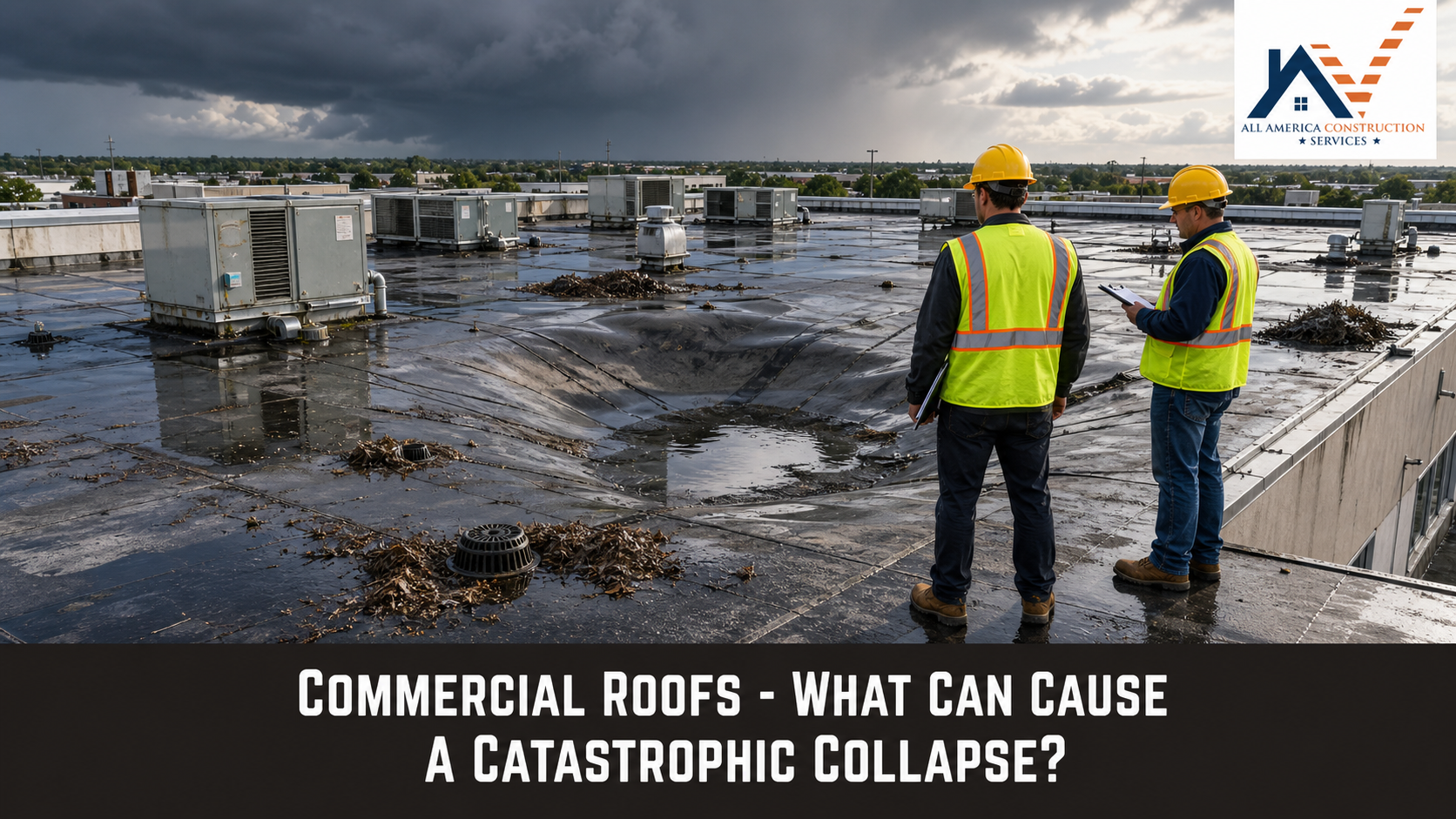
Each inch of water sitting on a roof adds roughly five pounds per square foot of surface area. On a small commercial roof of five thousand square feet, an inch of standing water represents twenty-five thousand pounds of load. Two or three inches across that same surface during a heavy Florida storm can approach or exceed the design load of the roof structure, especially if structural elements have been weakened by years of moisture exposure. Drain blockages during heavy rain are how these loads accumulate fast enough to overwhelm a roof, and they are statistically the single most common immediate cause of commercial collapse events.
How Drainage Problems Develop
Drains and scuppers do not usually fail dramatically; they accumulate debris quietly. Roof drains can be choked by leaves, palm fronds, gravel from older built-up roofs, and the general windborne debris that South Florida produces year-round. Scuppers can be partially blocked by sealant failures, displaced membrane, or accumulated debris. Internal drains can be obstructed by debris that fell in from above. Over months, none of this looks dramatic; during the first heavy storm of the season, however, the inadequate drainage suddenly cannot keep pace with the rain, water accumulates faster than it leaves, and the load on the structure climbs into ranges the building was never tested at.
Cause 2: Aging Structural Components and Hidden Decay
The roof structure itself ages, even when the membrane above it looks acceptable. In older commercial buildings this aging is often the deepest contributor to collapse risk.
Wood, Steel, and Concrete All Have Different Failure Modes
Commercial roof structures use different materials, and each ages differently. Wood structural members in older buildings can develop rot or fungal decay where moisture has been present for years, often invisible from beneath the ceiling. Steel beams and bar joists can corrode where moisture has reached them, particularly at connections and bearing points. Concrete elements can experience rebar corrosion or spalling. None of these processes are dramatic on any given day; they advance over years. The combined effect is a roof structure that nominally looks intact but has lost a meaningful portion of its load-bearing capacity. When a storm or accumulated water arrives, that reduced capacity is what determines whether the roof holds.
Why the Damage Is Often Invisible
The reason aging structural damage causes so many surprises is that it is largely hidden. The visible roof above looks acceptable. The visible ceiling below looks normal. The structural members themselves are concealed in the cavity between, where moisture damage advances out of sight. Periodic professional inspection that looks at the structure, not just the membrane and finishes, is what makes hidden decay visible early enough to address. Without that, the first sign the structure was compromised is often the failure itself.
Cause 3: Hurricane Wind and Storm Damage
Florida’s hurricane season produces forces that no other category of weather matches. Wind alone does not usually collapse a commercial roof, but wind combined with other weaknesses absolutely can.
Uplift Pressure at Edges, Corners, and Penetrations
Hurricane wind generates uplift forces that concentrate at roof edges, corners, and around penetrations. These forces can peel back roofing membranes, tear off equipment, and in severe cases lift sections of the roof structure itself. A roof whose anchoring and fastening have been compromised by age or by inadequate original installation is the roof most vulnerable to uplift damage. Wind events that leave neighbouring buildings essentially untouched can selectively damage one structure whose weak points happened to match the wind direction and intensity.
Combined Storm Damage Patterns
The most dangerous storm pattern combines wind, heavy rain, and the failure of one or more roof systems together. Wind damages membrane and equipment, rain pours into the damaged areas, drains fail to keep up with the volume, structural members soaked over the storm lose strength, and the combined load exceeds what the now-compromised structure can hold. This combination is rare, but it is the path most catastrophic storm-induced collapses follow. Each individual element might be manageable; together they create the conditions for serious failure. Knowing the team that handles emergency roof repair Broward County commercial properties depend on, before a hurricane arrives, is one of the practical preparations every commercial owner should have in place.
Cause 4: Equipment Loads Added Without Engineering Review
Over the life of a commercial building, equipment gets added to the roof. HVAC units replaced with larger models. Solar arrays installed. Antennas, satellite dishes, exhaust fans, and access ladders mounted. Each addition seems small at the time. Across years, the cumulative load on the roof can exceed what the original design accounted for, especially if any of those additions skipped engineering review.
HVAC, Solar, and Auxiliary Equipment
The largest contributors are usually HVAC units and solar arrays. Replacing an old HVAC system with a newer, heavier unit changes the point load at that location, and a building owner focused on functionality may not realise the structure was sized for the older equipment. Solar installations add dead load across large areas; quality solar contractors evaluate structural capacity before mounting arrays, but not every installation gets that review. Antennas, satellite equipment, mechanical penetrations, and rooftop walkways all add load too, in smaller increments. The combined load over time can drift well beyond the design assumptions of the original structure.
The Role of Engineering Review Before Adding Load
The prevention is straightforward in principle: before adding meaningful new load to a commercial roof, get a structural review from a qualified engineer. The review confirms whether the existing structure can carry the additional weight at the proposed locations, what reinforcement might be needed, and how the addition affects the roof’s overall load picture. This is routine practice for major installations and skipping it is one of the more avoidable contributors to long-term collapse risk. For buildings whose roofs have accumulated equipment over decades without consolidated review, a one-time structural assessment of the current loaded condition is itself good practice.
Cause 5: Compromised Repairs and Unauthorized Modifications
Repairs done badly can sometimes be worse than no repairs at all. The same is true of modifications made without understanding the structural implications.
Repairs That Do Not Address the Underlying Cause
A repair that covers a leak without addressing why the leak appeared can mask a problem that continues to advance beneath the surface. Water that was visible has now been hidden, while it continues to reach structural members where the real damage accumulates. Over the months and years following a cosmetic repair, the underlying decay can progress far enough that the building reaches a failure threshold without anyone realising. Quality repairs identify the underlying cause, address it at the source, and document what was done.
Modifications That Cut Into Structural Elements
Modifications that affect structural elements are another category of risk. Cutting through structural members to run mechanical penetrations, removing portions of a roof structure to enlarge an opening, or making changes that alter how loads transfer through the building all need engineering oversight. Modifications done without that oversight can create weak points that the original design never accounted for, and those weak points can sit unnoticed until a load test arrives. Permitting requirements exist partly to ensure this oversight happens; building owners should ensure any work touching the roof structure has appropriate review and documentation, both during and after the project.
Cause 6: Long-Term Moisture Intrusion to the Structure
Moisture is the slowest of the collapse contributors and often the most damaging. A roof that has been leaking slowly into its own structure for years carries cumulative damage that may not be visible until far too late.
The Path from Small Leak to Structural Damage
The path typically runs like this. A small leak develops at a flashing or penetration. The leak is not large enough to cause noticeable interior damage, so it goes unaddressed. Water finds its way into the roof structure, where it stays trapped in insulation, between layers, or in cavities. The trapped moisture supports fungal decay in wood, corrosion in metal, or deterioration in concrete components. Over years, this damage accumulates without any obvious external sign. The membrane above continues to look acceptable. The ceiling below continues to look normal. The structure between them is being compromised the whole time.
Why Catching Leaks Early Matters Even When They Look Minor
This is the strongest argument for treating every leak seriously, even when it is small. A leak in a flashing detail today is the seed of structural damage in five years if it is not addressed. Building owners who treat small leaks as one-day repairs spare their structures the cumulative damage that turns small problems into collapse risks. Conversely, the buildings most at risk are those with histories of unaddressed minor leaks that an owner never thought to escalate. Routine inspection and prompt repair are not just leak prevention; they are structural protection.
Warning Signs Building Owners Should Watch For
Catastrophic collapses are usually preceded by warning signs visible to anyone who knows what to look for. Recognising these signs can be the difference between an early intervention and an emergency.
Visible Sagging or Deflection
The clearest sign of structural concern is visible sagging or deflection of the roof, either looking up at it from inside or across at it from outside. Sags, dips, or low spots that were not there originally are signs the structure has begun to deform under load. Any new sagging, especially after a heavy rain or a storm, should be treated as a serious concern and the affected area should be considered restricted until a professional has evaluated it.
Cracking Sounds, New Cracks, and Sticking Doors
Less dramatic but equally important signs include cracking sounds from the structure, new cracks appearing in walls or ceiling finishes (especially near roof-supported walls), doors that start sticking or that no longer close properly, and any pattern of small structural anomalies that were not there before. None of these are guarantees of imminent collapse, but together they can indicate that the structure is moving in ways it should not be moving. They deserve professional evaluation rather than assumption.
Visible Water Damage, Stains, and Mould
Visible water damage on ceilings, persistent stains that grow over time, and mould growth in ceiling areas all suggest moisture is reaching places it should not. While these are most directly leak signs, they can also indicate that water has been reaching structural members over time. A building with visible moisture history warrants a more thorough structural review than a building without one, since the cumulative damage may exceed what surface inspection reveals.
Warning Sign | What It May Indicate | Recommended Response |
New sagging or deflection | Structural deformation under load | Restrict area, emergency assessment |
Cracking sounds | Structure moving or settling | Professional evaluation promptly |
New wall or ceiling cracks | Movement transferring to finishes | Investigate cause, structural review |
Doors sticking or warping | Possible frame movement | Structural inspection |
Persistent water stains | Active or historic leak | Locate source, assess structural impact |
Standing water 48+ hours | Drainage failure, load on structure | Drainage repair, structural review |
Preventing the Conditions That Lead to Collapse
The good news is that almost everything that causes catastrophic collapse can be prevented or interrupted earlier. Prevention does not require expensive engineering at every step; it requires consistent attention.
Twice-Yearly Professional Inspections
The foundation of prevention is regular professional inspection, twice a year for South Florida commercial roofs, with additional inspections after major storms. These inspections should explicitly look at structural condition, not just membrane condition, and include attention to the underlying systems and any equipment loads on the roof. The cost of these inspections is small compared with the cost they prevent. Documented records of inspections over time also support insurance conversations if a future event causes damage despite preventive efforts.
Prompt Repair and Structural Review When Warranted
Whatever an inspection finds should be addressed promptly. Small repairs done now are vastly cheaper than the larger problems they prevent. Where structural concerns surface, a qualified engineering review should be the next step, and any work that addresses structural elements should be properly permitted, documented, and inspected. Building a relationship with a roofing contractor who can coordinate this process simplifies the work significantly, since the contractor manages the moving parts and the building owner gets one point of contact through the entire process.
How All America Construction Services Helps Prevent the Conditions That Lead to Collapse
All America Construction Services treats commercial roof safety as a structural conversation, not just a membrane conversation. The team handles inspection, maintenance, repair, restoration, and full replacement, and coordinates with structural engineers when structural review is part of the picture.
Inspection Programs That Look at the Whole System
Most commercial customers benefit most from a documented inspection and maintenance program tailored to the building. The team walks the roof on a scheduled cadence, evaluates structural conditions where visible, addresses small problems before they grow, and keeps records that support both planning and any future insurance conversation. The same crew handles emergency response if a storm causes damage, so the building has continuity across all of its roofing touchpoints.
Schedule a Commercial Roof Assessment
If your commercial property has any of the warning signs described in this article, or if your roof has not had professional structural attention in years, do not wait. Request a commercial roof assessment and start the conversation while options are still wide open. Most of the conditions that lead to catastrophic collapse are entirely manageable when identified early. The question is whether they get identified early enough.
Frequently Asked Questions
How common are commercial roof collapses?
They are rare in absolute terms but devastating when they happen. Most commercial buildings never experience a catastrophic collapse, but the buildings that do almost always carry warning signs that were unrecognised or ignored beforehand. Prevention through regular inspection and prompt repair is what keeps any given building in the safe category.
What is the most common cause of commercial roof collapse in Florida?
Ponding water during heavy storms is the most common immediate cause. Drains and scuppers blocked by debris allow water to accumulate beyond the design load, and a structure already weakened by years of moisture or other factors then fails under that additional weight. Drain maintenance is one of the highest-value preventive practices for South Florida commercial roofs.
Can hidden structural damage cause a collapse?
Yes, and it is one of the most concerning causes precisely because it is hidden. Wood members rotting from long-term moisture, steel corroding at connections, or concrete deteriorating internally can all reduce load capacity invisibly. Regular professional inspection that looks at the structure, not just the membrane and finishes, is the practical way to catch hidden damage before it matters.
Does adding rooftop equipment increase collapse risk?
It can, especially over time as multiple additions accumulate. HVAC replacements, solar installations, antennas, and other equipment add load to the structure. Before significant additions, an engineering review should confirm the existing structure can carry the new weight at the proposed locations. For buildings that have accumulated equipment over decades without consolidated review, a current-load assessment is worth scheduling.
What warning signs should building owners watch for?
Visible sagging or deflection of the roof, new cracks in walls or ceilings, cracking sounds from the structure, doors that start sticking, and persistent or growing water damage are the main signs to take seriously. None guarantees imminent collapse, but together they can indicate the structure is moving in ways it should not. They warrant professional evaluation rather than assumption.
Does All America Construction Services handle commercial roof inspections?
Yes. The team handles inspection, maintenance, repair, restoration, and replacement across commercial properties in South Florida, with the same crew available for emergency response when storms cause urgent damage. Most customers benefit from a documented twice-yearly inspection program tailored to the building’s age, type, and exposure.
How do I schedule a structural commercial roof assessment?
Contact All America Construction Services to request an assessment. The visit looks at the membrane and the structural condition visible from above and below where access allows, identifies any concerns, and recommends the appropriate next steps, which may include engineering review for buildings where structural questions surface. Acting during calm weather is meaningfully better than waiting for an emergency to force the conversation.