
If your home sits within a few miles of the water in Miami-Dade County, the roof over your head works harder than almost any other part of the house. It faces salt-laden air every single day, absorbs relentless summer heat, and has to hold its ground when hurricane-season winds arrive. That combination is exactly why so many coastal homeowners start asking whether metal is the smarter long-term answer. Choosing metal roofing Miami-Dade County homeowners can rely on is less about following a trend and more about matching the material to a genuinely demanding coastal environment. This guide walks through the real decision, covering corrosion, wind uplift, heat and energy behavior, the systems that suit coastal exposure, and the lifespan you should expect for the investment. If you want to talk it through with a licensed local roofer, the team at All America Construction Services works throughout the county and understands coastal conditions first hand.
Why Coastal Conditions Change the Roofing Decision in Miami-Dade
A roof that would last decades in a dry inland climate can age far faster along the Miami-Dade coast, and that is the single most important thing to understand before you compare materials. Living near the ocean means your roof is exposed to a stack of stresses that inland homes rarely face at the same intensity. Salt in the air settles on every surface and speeds up corrosion. The sun is intense and direct for most of the year, pushing attic and surface temperatures high and cooking materials that are not built to handle it. And because Miami-Dade sits in one of the most wind-vulnerable regions in the country, every roof here has to be engineered for storm forces rather than ordinary weather.
When you evaluate a roofing material for a coastal home, you are really asking three questions at once. Can it resist salt corrosion over the long haul? Can it stay attached and intact when hurricane winds pull upward on it? And can it manage heat well enough to keep your home comfortable without punishing your energy bills? Traditional materials answer some of those questions but not always all of them together. Metal roofing has become popular in coastal South Florida precisely because, when it is specified and installed correctly, it can address all three at once.
The word “correctly” carries a lot of weight in that sentence. Not every metal roof is built for salt air, and not every installer details a metal system the way coastal exposure demands. So the honest question is not simply “is metal good?” but “is the right metal system, installed the right way, the best long-term fit for this specific home near the water?” That is the decision this article is built to help you make.
How Metal Roofing Stands Up to Salt Air and Corrosion
Corrosion resistance is where coastal metal roofing either proves its value or quietly disappoints, so it deserves the most careful attention. Salt air is corrosive because airborne salt particles hold moisture against metal surfaces and accelerate oxidation. A metal roof that is a great choice ten miles inland may not be the right specification for a home two blocks from the beach. The good news is that the metal roofing industry has developed materials and coatings specifically for this environment, and a knowledgeable contractor will steer you toward them.
Aluminum is often the standout performer for homes closest to the ocean. It forms a natural protective oxide layer that resists salt corrosion well, which is why you see it used so often on beachfront and near-shore properties. Coated steel, particularly steel finished with a metallic coating such as a zinc-aluminum alloy and then a high-performance paint system, can also perform strongly, but the coating quality and the integrity of every cut edge and fastener matter enormously. Bare or lightly protected steel is generally not a wise choice in a salt-heavy setting.
Finishes carry much of the corrosion defense on a coated metal roof. Premium paint systems, often built on PVDF resin chemistry, are engineered to hold color and resist the chalking, fading, and breakdown that salt and ultraviolet exposure cause over time. When a coating fails, corrosion follows quickly, so the finish is not a cosmetic detail near the coast. It is a functional part of how long the roof will last. Manufacturer partners that All America Construction works with, including Englert and PAC-Clad, produce coated metal systems designed for demanding environments, and matching the finish to your distance from the water is part of a responsible specification.
Details often decide the outcome more than the panels themselves. Fasteners, flashings, clips, and trim need to be compatible with the roofing metal so that dissimilar metals do not react and corrode where they touch. Mixing the wrong metals, for example using incompatible fasteners on an aluminum panel, can create galvanic corrosion that undermines an otherwise excellent roof. This is one of the clearest reasons coastal metal roofing rewards an experienced installer who selects compatible components from edge to ridge.
How Metal Handles Wind Uplift in a High Velocity Zone
Miami-Dade County sits inside the High Velocity Hurricane Zone, the most stringent wind-design region in the Florida Building Code, and that reality shapes every roofing decision here. Wind does not simply push against a roof. As it flows over and around the building, it creates powerful uplift forces that try to peel the roof off, and those forces are strongest at edges, corners, and ridges. A coastal roof has to be engineered and attached to resist that uplift, not just to shed rain.
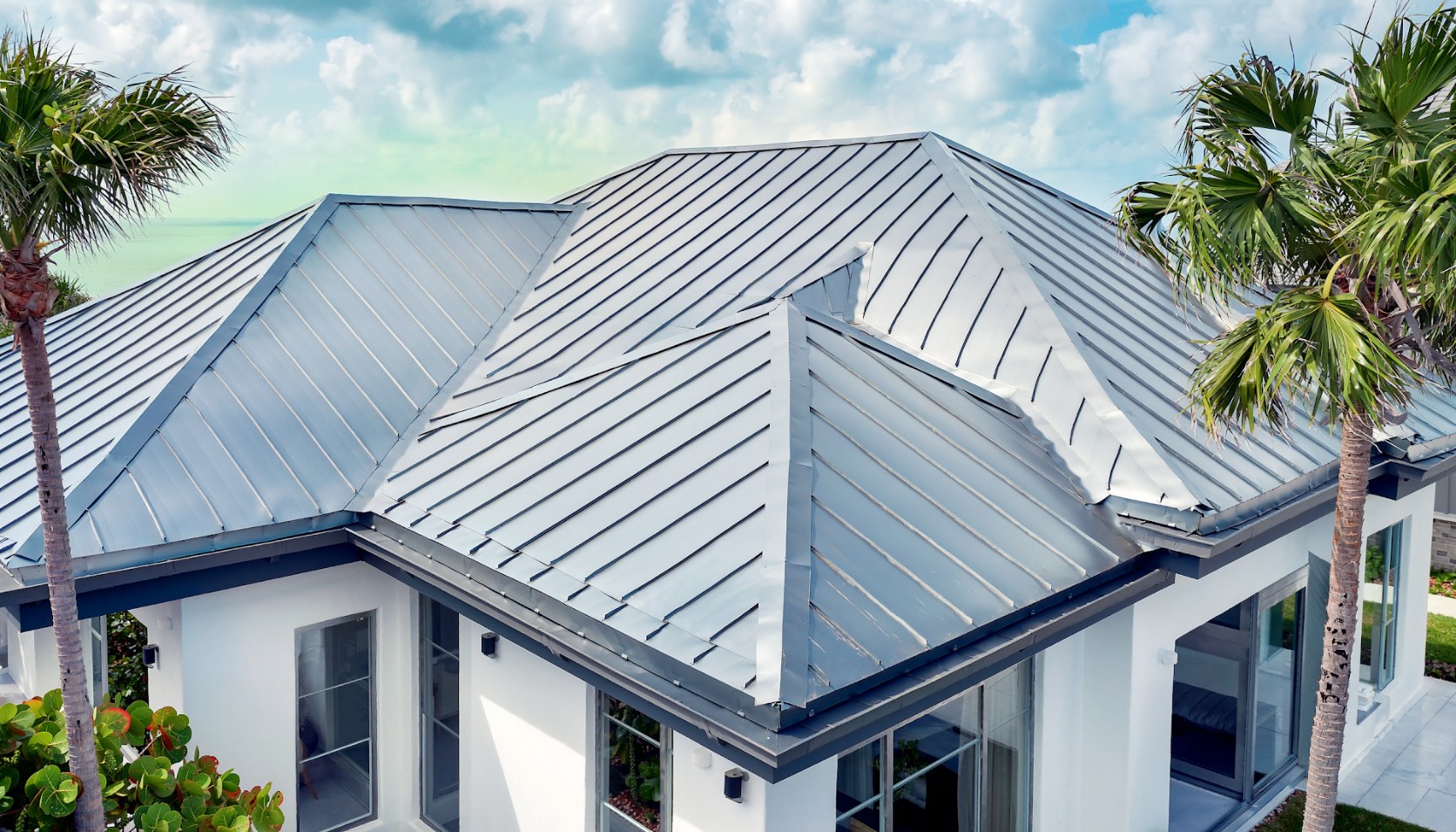
Metal roofing can perform very well under uplift when the system is designed for it, and that is a meaningful advantage in a place like Miami-Dade. The key is not the metal alone but the complete assembly, meaning the panels, the attachment method, the underlayment, and the way the whole thing is fastened to the structure. Standing seam systems, where panels are joined by raised seams and secured with concealed clips, are frequently specified in high-wind areas because the fasteners are protected and the panels can be engineered to lock together tightly.
What matters most from a homeowner’s standpoint is documentation. In the HVHZ, roofing products are expected to carry approvals that confirm they have been tested for this environment, including a Miami-Dade Notice of Acceptance or a Florida Product Approval, along with a design pressure rating suited to your home’s exposure. An honest contractor will show you that a proposed metal system carries the approvals required for Miami-Dade and explain how it is rated for the uplift your specific roof will face. That paperwork is not bureaucratic filler. It is your evidence that the roof is genuinely built for local storms.
Installation quality then turns that engineering into real protection. Correct fastening patterns, properly spaced clips, reinforced edges, and secure flashing at every transition are what allow a metal roof to hold together when a storm arrives. Even the best panel in the country will underperform if it is attached poorly. This is why the wind story and the installer story are inseparable, and why choosing a contractor experienced in HVHZ metal work is part of choosing metal itself.
What Metal Roofing Does for Heat and Energy in South Florida
In a climate where the air conditioner runs most of the year, how a roof manages heat has a direct effect on comfort and operating costs, so energy behavior belongs at the center of the decision. Metal roofing has a reputation for reflecting solar energy rather than soaking it up, and that reputation is largely deserved when the roof uses the right finish. Reflective and cool-rated coatings are designed to bounce a significant share of the sun’s energy away, which helps keep the roof surface and the attic below it cooler.
A cooler attic tends to translate into a more comfortable home and a lighter load on your cooling system during the long South Florida summer. It is important to be realistic here rather than promising specific numbers. The actual energy effect depends on your insulation, attic ventilation, roof color, home orientation, and how the roof assembly is built. A responsible contractor will describe the benefit as a meaningful improvement that varies from home to home, not as a guaranteed dollar figure on your utility bill.
Color and finish give you real control over that thermal performance. Lighter and specially engineered cool-roof colors typically reflect more solar energy than dark ones, and cool-rated pigments can improve reflectivity even in richer tones. Because metal roofs come in a wide range of profiles and finishes, you can usually find a look you like that still supports your energy goals, which is a genuine advantage over materials with fewer reflective options.
There is a second energy angle worth noting for South Florida homeowners. Many metal roofs pair well with solar, and a durable metal roof can be a strong foundation for a future solar installation because the roof is likely to outlast the panels mounted on it. That is a separate project and decision, but if solar is on your long-term radar, the durability and clean mounting surface of a metal roof are worth keeping in mind as you weigh materials now.
Which Metal Roofing Systems Suit a Coastal Home
Not all metal roofing is the same, and the differences matter more near the water, so it helps to understand the main systems before you decide. The two broad categories are standing seam and exposed-fastener panels, and the two common metals for coastal homes are aluminum and coated steel. Each combination has a place, and the right one depends on how close you are to the ocean, your budget range, the look you want, and how much long-term maintenance you are willing to accept.
Standing seam is the system most often recommended for demanding coastal and high-wind settings. Its fasteners are concealed beneath the raised seams, which protects them from salt exposure and reduces the number of penetrations through the panel. Exposed-fastener panels, where screws pass through the face of the metal, cost less and install faster, but each fastener is a potential entry point for water and a spot where corrosion can begin if the wrong components are used. Near the coast, that difference deserves real thought.
On metal choice, aluminum is prized for salt resistance and is a frequent first pick for homes very close to the water, while coated steel offers strength and value and performs well when the coating and finish are matched to the environment. The table below summarizes how the common coastal options compare, so you can see the trade-offs side by side rather than in the abstract.
Metal System | Coastal Strengths | What to Consider |
Standing seam aluminum | Excellent salt-corrosion resistance and concealed fasteners suited to near-shore homes | Typically a higher upfront investment and needs an experienced installer |
Standing seam coated steel | Strong wind performance with protected fasteners and durable premium finishes | Coating and finish quality must match your distance from the water |
Exposed-fastener metal panel | Lower upfront cost and faster installation for budget-focused projects | Exposed fasteners are wear points that need compatible components and more upkeep near salt air |
There is no single correct answer for every coastal home, which is why a site-specific recommendation matters. A house directly on the water may point clearly toward standing seam aluminum, while a home a mile or two inland might be well served by a quality coated-steel system at a friendlier price point. A local contractor who evaluates your exposure, roof geometry, and goals can match the system to your situation rather than selling a one-size-fits-all product.
What Lifespan and Maintenance Look Like Over Time
The strongest argument for metal on a coastal home is usually longevity, so it is worth understanding what lifespan realistically means here and what the roof asks of you in return. A well-specified and well-installed metal roof can last for many decades, often ranging well beyond the service life of a typical asphalt shingle roof in the same climate. That extended life is a large part of how the higher upfront investment is justified, because the cost is spread across far more years of protection.
On the money question, it is only fair to talk in ranges rather than fixed figures, because the honest answer depends on your specific home. Metal roofing generally carries a higher upfront investment than asphalt shingles, and standing seam aluminum sits toward the upper end of the metal range while exposed-fastener steel sits lower. What you gain for that investment is durability, storm resilience, and a roof that may never need full replacement while you own the home. A trustworthy contractor will present these figures as a range tied to your roof size, slope, system choice, and coastal exposure, not as a single guaranteed number.
Maintenance is lighter with metal than many homeowners expect, but near the coast it is not zero. Periodic rinsing to remove accumulated salt, routine inspections after major storms, and prompt attention to any damaged finish or loosened flashing all help a coastal metal roof reach its full potential lifespan. The maintenance is simple, but skipping it in a salt environment shortens the very lifespan you paid a premium to get. Think of it as low effort rather than no effort.
When you weigh the longer lifespan, the storm resilience, and the modest upkeep together, metal often makes strong financial and practical sense for a coastal Miami-Dade home even though it costs more at the outset. The decision comes down to how long you plan to stay, how much you value durability and peace of mind through hurricane season, and whether the upfront range fits your plans for the property.
What to Confirm Before Choosing Metal for Your Home
Once you are leaning toward metal, a short list of confirmations helps you make the decision with confidence rather than guesswork. These are the practical checks that separate a roof that will serve you for decades from one that only looked good on paper. Walk through them with any contractor you are considering, and pay attention to how clearly and honestly they answer.
• Confirm the metal and finish are specified for your exact distance from the water, favoring aluminum or high-quality coated steel with a premium finish near the shore.
• Ask to see the Miami-Dade Notice of Acceptance or Florida Product Approval and the design pressure rating for the proposed system.
• Verify that all fasteners, flashings, and trim are compatible with the roofing metal to prevent galvanic corrosion.
• Discuss standing seam versus exposed-fastener options and why one suits your home better than the other.
• Ask how the contractor details edges, ridges, and penetrations, since these are the points where wind and water do the most damage.
• Get the expected lifespan, warranty terms, and investment presented as clear ranges tied to your specific roof.
Working through these points does two things at once. It gives you the information you need to decide, and it reveals how experienced and straightforward a contractor really is with coastal metal work. A roofer who welcomes these questions and answers them plainly is showing you the kind of transparency you want on a decades-long investment. A roofer who brushes them off is telling you something too. For a coastal Miami-Dade home, the quality of the answers matters just as much as the quality of the metal.
If you are weighing metal roofing for a coastal Miami-Dade home, the best next step is a straightforward conversation with a licensed local roofer who knows how salt air, wind, and heat behave in this county. All America Construction Services can inspect your home, assess your coastal exposure, and walk you through the metal systems and finishes that fit your property, your goals, and your budget range. Call (954) 225-6087 or email customerservice@allamericacs.com to schedule an inspection or estimate and get honest, homeowner-focused guidance before you commit to a roof that should last for decades.
Frequently Asked Questions
Is metal roofing a good choice for a home right on the water in Miami-Dade?
Yes, metal is often one of the strongest choices for near-shore homes when the right system is specified. Aluminum and high-quality coated steel with premium finishes resist salt corrosion well, and standing seam systems keep fasteners protected from salt exposure. The key is matching the metal, finish, and detailing to your exact distance from the water.
How does metal roofing hold up to hurricane winds in the High Velocity Hurricane Zone?
A properly engineered and installed metal roof can perform very well against wind uplift in the HVHZ. What matters is the complete assembly, including the panels, attachment method, and fastening, along with the required Miami-Dade Notice of Acceptance or Florida Product Approval. Ask your contractor to confirm the system is rated for your home’s specific exposure.
Does a metal roof really help with energy costs in South Florida?
Metal roofs with reflective or cool-rated finishes can bounce away a meaningful share of solar energy, which helps keep the attic cooler and can ease the load on your air conditioner. The actual effect varies with your insulation, ventilation, roof color, and home design, so it is best described as a real improvement that differs from home to home rather than a guaranteed savings figure.
How long can a coastal metal roof be expected to last?
A well-specified and well-installed metal roof can last for many decades, often far longer than a typical asphalt shingle roof in the same climate. Near the coast, reaching that full lifespan depends on choosing corrosion-resistant materials and keeping up with simple maintenance like periodic rinsing and post-storm inspections. The exact lifespan depends on your system choice and how close you are to the water.
Which metal roofing system is best for a coastal Miami-Dade home?
For homes very close to the water, standing seam aluminum is frequently the top recommendation because of its salt resistance and concealed fasteners. Coated steel systems can be an excellent value a bit farther from the shore when the coating and finish match the environment. A local contractor can assess your exposure and recommend the right system rather than a single default option.
Does a metal roof need much maintenance in a salt-air environment?
Metal roofs are relatively low maintenance, but coastal homes benefit from a little routine care. Periodic rinsing to remove salt buildup, inspections after major storms, and prompt attention to any damaged finish or loose flashing all help the roof reach its full lifespan. The upkeep is simple, but it should not be skipped near the ocean.
Is metal roofing worth the higher upfront investment for a coastal home?
For many coastal homeowners it is, because the longer lifespan, storm resilience, and low maintenance can offset the higher initial cost over time. Whether it makes sense for you depends on how long you plan to stay in the home and how much you value durability through hurricane season. A contractor can present the investment as a clear range tied to your specific roof so you can decide with confidence.