

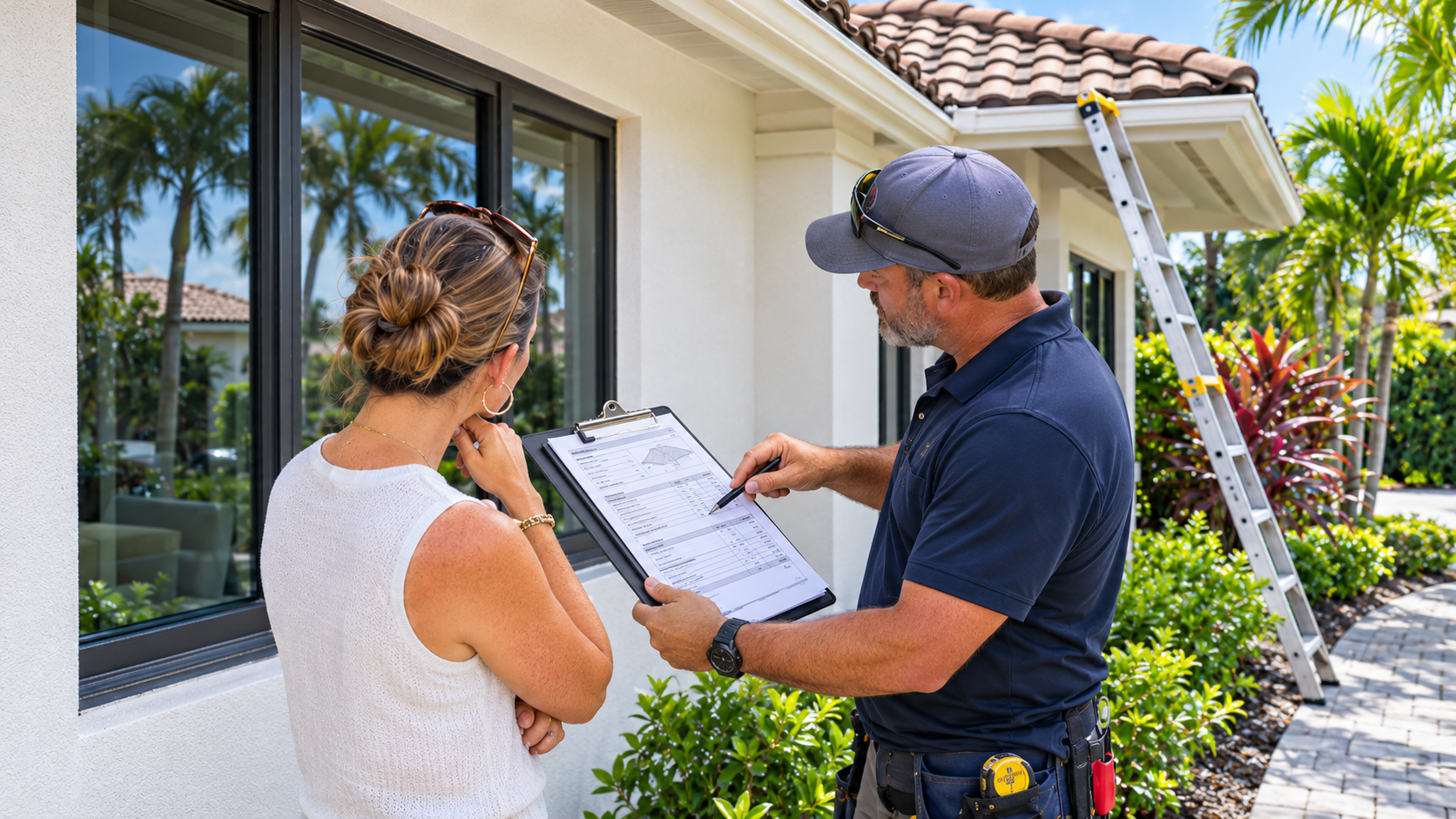
Quick answer: Before hiring a roofer in West Palm Beach County, confirm three things in writing. Verify the contractor holds an active Florida roofing license through the Department of Business and Professional Regulation, confirm current general liability and workers compensation insurance, and make sure permits are pulled in the roofer’s name rather than yours. A legitimate licensed roofer will hand over each of these without hesitation.
Hiring a roofer ranks among the larger financial decisions a Palm Beach County homeowner makes, and in a market this exposed to hurricanes the margin for error is thin. If you are searching for licensed roofers in West Palm Beach County, the license is only the first checkpoint, not the finish line. Real verification means confirming the license is genuine, active, and tied to the exact person or company named on your contract, then checking the insurance and permits that protect you if the job goes wrong.
Roofing attracts more unlicensed activity than almost any trade in Florida, and it spikes every time a named storm crosses the county. Out-of-town crews and door-knocking salespeople appear within days, promise a fast turnaround, and sometimes vanish once a deposit clears. Ten minutes of checking is what separates a credentialed roofer from someone who leaves you with an unpermitted roof, a voided insurance claim, and no working phone number to call.
Verification protects four things at once. It protects your money, because a licensed and bonded contractor is accountable in a way a cash-only crew is not. It protects your insurance, because Florida carriers tie coverage to properly permitted work. It protects your resale value, because a buyer’s inspector and lender will ask for permit history. And it protects the people on your roof, because a real contractor carries coverage for them. This guide walks through exactly what to confirm before you hire licensed roofers in West Palm Beach County, in the order a careful homeowner should follow, from the state license through insurance, permits, local track record, and the warning signs that should stop a deal cold.
Why Verifying a Roofer Matters More in Palm Beach County
Verification carries more weight in Palm Beach County than in most of the country because the roofs here take a beating and the rules around them are strict. Homes from Boca Raton and Delray Beach up through West Palm Beach, Wellington, Royal Palm Beach, and Jupiter sit in a wind-borne debris region under the Florida Building Code, just north of the High-Velocity Hurricane Zone that covers Miami-Dade and Broward. That means high wind-load requirements, tight product-approval rules, and inspections that an unlicensed crew is simply not equipped to pass.
Location within the county changes the demands too. Barrier island and near-coastal homes deal with salt air and the highest design wind speeds, while inland communities still face heavy summer rain, wind-driven water, and afternoon storms that expose weak flashing and poor underlayment. A roofer working here needs to understand Florida Building Code detailing, not just how to lay shingles, and the license is the baseline proof that the state has tested them on it.
Insurance is the other reason verification matters. Florida carriers scrutinize roof age, installation quality, and permit history closely, and many will only honor a claim or renew a policy when the work was done by a licensed contractor and closed out with a passed final inspection. A cut-rate roof installed without a permit can quietly disqualify a future claim or trigger a non-renewal, which turns a short-term saving into a long-term liability.
The state’s property insurance market has made this even more pressing. Carriers across Florida have tightened their rules on roof age and condition, and some now require a recent inspection or proof of remaining useful life before they will write or renew a homeowner policy. Work completed by a licensed contractor and closed under a permit produces the documentation an insurer or a future buyer will eventually ask for. Undocumented work leaves a paperwork gap that tends to surface at the worst possible moment, during a claim after a storm, when you can least afford a dispute over whether the roof was done correctly.
Storm-chasing hits this county hard as well. After a hurricane, older residents and seasonal homeowners are frequent targets for high-pressure pitches and deposit-and-disappear schemes. Confirming a roofer’s credentials before any money changes hands is the single most reliable defense, and the most reputable licensed roofers in West Palm Beach County expect the question and answer it without hesitation.
How to Check a Roofing License Through the Florida DBPR
You can verify a Florida roofing license for free in about 5 minutes through the Department of Business and Professional Regulation, the state agency that licenses contractors. The DBPR keeps a public database of every certified and registered contractor, along with their license status, issue and expiration dates, and any disciplinary history.
Start by asking the contractor for the license number and the full legal name printed on the license, then run the check yourself rather than trusting a printout or a screenshot. You can verify a contractor’s license through the Florida DBPR using the state’s online license search.
• Ask for the exact license number and the full legal name or business name on the license.
• Enter the license number in the DBPR search, or search by the individual or company name if you do not have the number.
• Confirm the status reads Current and Active, not Delinquent, Expired, or Null and Void.
• Match the name on the license to the name on your written estimate and contract.
• Read the record for disciplinary actions, complaints, or a history of surrendered licenses.
While you are checking, it helps to confirm the business itself exists as a registered Florida entity through Sunbiz, the state’s Division of Corporations website. A license attached to a company with no corporate registration, or one that was dissolved years ago, is a reason to slow down and ask questions.
The DBPR record shows more than a simple yes or no. It lists the license type and number, the issue and expiration dates, the qualifier tied to a business, and any complaints or disciplinary orders on file. A license that expired months ago, or one carrying a pattern of complaints, tells you as much as an active status does. Take a moment to read the full record rather than stopping at the first green light, because the details are where a problem history usually shows itself.
If the name does not turn up, try searching by the individual’s name instead of the company, and double-check the spelling. When you still cannot find a record, call the DBPR directly at (850) 487-1395 before you go any further. A contractor who cannot produce a verifiable license is not a contractor you should be paying.
Certified Versus Registered Roofing Contractors
Florida issues roofing licenses in two forms, and the difference matters for a Palm Beach County job. A Certified Roofing Contractor holds a license with the CCC prefix that is valid anywhere in the state, while a Registered Roofing Contractor holds an RC license that is only valid in the specific local jurisdictions that recognized the registration. Roofing is its own certified contractor category under Florida law (Florida Statutes 489.105), administered by the Construction Industry Licensing Board within the DBPR.
For most homeowners, a Certified Roofing Contractor is the cleaner answer, because the statewide license leaves no question about local recognition. If a roofer holds a registered license instead, confirm that the registration is valid in your municipality before hiring, whether that is the city of West Palm Beach, unincorporated Palm Beach County, or a neighboring city with its own building department. A general contractor can also legally perform roofing in many cases, but for a roof-only project a dedicated roofing license is the credential that fits the work.
What an Active License Status Really Confirms
An active license status confirms the state issued the license and it is current, but it does not confirm three things you still need to check. It does not prove the contractor carries insurance, it does not guarantee the person estimating your job is the licensed party, and it does not tell you whether the crew doing the work is qualified.
Many roofing companies operate under a licensed qualifier, a single license-holder who legally stands behind the business. The salesperson at your door may be an employee or a subcontractor working under that qualifier, so match the qualifier’s name and license number to the company printed on your contract. If those names do not line up, ask why before signing, because a mismatch can mean the person selling the job has no real authority to stand behind it.
It is fair to ask who will actually be on your roof. Some companies use their own employees, while others subcontract the labor to separate crews. Neither approach is wrong on its own, but you want to know that whoever performs the work is covered by the same license, insurance, and warranty you verified, rather than an unrelated crew brought in for the day. Getting the license number written directly into the contract, alongside the company name, closes the gap between the credentials you checked and the people who show up.
Confirm General Liability and Workers Compensation Coverage
A roofing license does not prove a contractor is insured, so confirm general liability and workers compensation separately, in writing, before a crew touches the roof. These are two different protections, and a homeowner needs both.
General liability covers damage the contractor causes to your property, from a fall that cracks a skylight to water intrusion during an open-roof stage of the job. When you request the Certificate of Insurance, ask to be listed as an additional insured or to have your property address noted, and check the policy limits so a serious loss would actually be covered rather than only a fraction of it.
Workers compensation covers injuries to the crew, and it matters more than most homeowners realize. Roofing is one of the highest-risk trades in Florida, and if a worker is hurt on your property while the contractor carries no workers compensation, you can be pulled into the liability. Ask for a Certificate of Insurance that lists your name or property address, then call the insurance agent or carrier printed on the certificate to confirm the policy is active and paid, because certificates can be outdated or forged.
For the strongest confirmation, ask the contractor to have their insurance agent send the Certificate of Insurance to you directly. A certificate that arrives straight from the agent’s office is far harder to alter than one the contractor prints and hands over, and the agent can confirm on the same call that the general liability and workers compensation policies are active on the day your work is scheduled, not lapsed or cancelled in the meantime.
Some sole proprietors carry a state workers compensation exemption, which can be legitimate for a solo operator. It is a warning sign, though, when a full crew is going to be working two stories up under an exemption meant for one person. If a bid comes in far below the others, missing insurance is often the reason it is cheaper, and that discount comes straight out of your own protection.
Make Sure the Permit Is Pulled in the Roofer’s Name
A licensed roofer pulls the building permit under their own license, and you should insist on it every time. In Palm Beach County and its cities, roof replacement requires a permit and a series of inspections, and the party who pulls the permit is the party the building department holds responsible for meeting code.
Be very cautious if a contractor asks you to pull an owner-builder permit. Doing so makes you, the homeowner, legally responsible for the work, for code compliance, and potentially for injuries to uninsured workers on the job. It also waives protections you would otherwise have and can complicate a future sale, because the work was never certified to a licensed contractor. Roofers suggest this shortcut to move faster or to sidestep their own licensing limits, and neither reason serves you.
A permitted roof also moves through required inspections, typically a dry-in inspection after the underlayment goes down and a final inspection once the roof is complete. Those checkpoints confirm the roof meets current Florida Building Code and that any required product approvals were followed. Ask to see the permit before the first shingle comes off, and confirm the final inspection passes before you release final payment. A permit in the contractor’s name, closed out with a passed inspection, is your proof that the roof will hold up under both insurance and resale scrutiny.
Florida also uses a document called a Notice of Commencement for permitted construction, which is recorded before work begins and identifies the property, the contractor, and the parties involved. Knowing this paperwork exists helps you spot a contractor trying to work off the books, because a roofer who avoids the permit and the notice is usually avoiding the accountability that comes with them. Ask how the permitting and inspection process will be handled at the estimate stage, not after the crew arrives, so there are no surprises once the tear-off starts.
Credentials and Local Track Record Worth Checking
Once the license, insurance, and permit checks clear, look at credentials and local history to judge quality rather than just legality. Manufacturer certifications, verifiable references, and a genuine presence in Palm Beach County are what separate a competent roofer from a merely legal one.
Manufacturer certifications can affect your warranty directly. Roofing material makers certify installers who meet their training standards, and those certified installers can often register stronger, longer workmanship warranties than an uncertified crew can offer. Ask which manufacturers the roofer is certified or partnered with, get the warranty terms in writing, and confirm the certification the same way you confirmed the license.
Read the contract for the difference between a manufacturer warranty on the materials and a workmanship warranty on the installation, since a leak caused by poor installation is only covered by the latter. A roofer who explains both clearly, in writing, is showing you how they will handle a problem later.
Florida construction lien law is one more reason paperwork matters. Suppliers and subcontractors who are not paid by your roofer can, in some situations, place a lien on your home even after you have paid the contractor in full. Ask how the roofer handles payments to suppliers and subcontractors, and request final lien releases before your last payment, so a dispute between the contractor and a supplier never becomes your problem to untangle.
Comparing more than one written estimate protects you as well. Ask two or three licensed roofers for itemized proposals, then compare them line by line rather than on the bottom number alone. A bid that is dramatically lower usually reflects thinner materials, a smaller crew, skipped steps, or missing insurance, and reading the scope side by side is how those gaps become visible before you sign rather than after the work is done.
Local track record is the final signal. Favor a contractor with a verifiable physical address, years of work in Palm Beach County, and references from nearby neighborhoods you can actually call. All America Construction Services is a licensed Florida roofing contractor that has served South Florida homeowners since 2018, works with roofing manufacturers such as CertainTeed and Englert, and welcomes homeowners verifying its credentials before hiring. You can review its roofing services for West Palm Beach County homeowners as one example of how a licensed local roofer should present its qualifications.
Warning Signs That Should Make a Homeowner Pause
Certain behaviors reliably signal a roofer you should walk away from, and most of them show up before any contract is signed. Treat any one of these as a reason to slow down and verify harder rather than a small quirk to overlook.
• A salesperson knocks on your door after a storm and pressures you to sign the same day.
• The contractor wants a large cash deposit before a permit is pulled or a contract is signed.
• The license number does not match the name on the contract, or they will not provide one at all.
• They suggest you pull an owner-builder permit to save time or money.
• There is no written contract, or the estimate lacks a breakdown of materials, underlayment, and warranty.
• The business has no local address, no verifiable reviews, and only a cell phone number.
• They offer to waive, absorb, or pay your insurance deductible.
That last one deserves a specific warning. Florida law prohibits roofing contractors from offering to pay or waive a homeowner’s insurance deductible, so a roofer who dangles that offer is either uninformed about the rules or willing to break them. Either way, it tells you how they are likely to treat the rest of the job.
Pressure and secrecy are the common thread across every warning sign. A contractor who is confident in their license, insurance, and permit process has no reason to rush you or to keep paperwork out of your hands, so any push to skip verification is itself the signal.
A common Palm Beach County scenario shows how these signs stack up. A crew canvasses a neighborhood a few days after a storm, offers to inspect the roof for free, then reports serious damage and urges the homeowner to sign a contract and pay a deposit that afternoon so they can lock in a spot. A homeowner who pauses to ask for the license number, verify it through the DBPR, and confirm insurance before signing gives up nothing except the pressure, and that pause is often enough to send a questionable crew looking for an easier target.
Your Pre-Hire Roofer Verification Checklist
Use this checklist as a final pass before you sign anything. Each row is something you can confirm in one short conversation or one online search, and a trustworthy roofer will help you check every line rather than resist it.
What to verify | Where to check it | What a solid answer looks like |
Active roofing license | DBPR license search at MyFloridaLicense | Status reads Current and Active, name matches your contract |
License type | The DBPR license record | Certified Roofing Contractor (CCC), valid statewide |
General liability insurance | Certificate of Insurance, confirmed with the insurer | Active policy that lists your project or property |
Workers compensation | Certificate of Insurance or state exemption record | Active coverage for every crew member on the roof |
Building permit | Your Palm Beach County or city building department | Permit pulled in the contractor’s own name |
Written contract | The contractor’s signed proposal | Itemized scope, materials, warranty, and payment schedule |
Working through this list takes far less time than recovering from a bad roof job. The most reputable licensed roofers in West Palm Beach County will move through every item with you, because standing behind their license, insurance, and permits is exactly what earns your trust and your business.
Get a licensed West Palm Beach County roof inspection from a team whose license, insurance, and permits you can verify, or call All America Construction Services at (954) 225-6087 to schedule.
Frequently Asked Questions
How do I check if a roofer is licensed in West Palm Beach County?
Verify the license for free through the Florida Department of Business and Professional Regulation at MyFloridaLicense. Enter the contractor’s license number, or search by the individual or business name, then confirm the status reads Current and Active and that the name matches your contract. If nothing comes up, call the DBPR at (850) 487-1395 before hiring.
What kind of license does a roofer need in Palm Beach County?
A roofer needs either a Certified Roofing Contractor license, which carries the CCC prefix and is valid statewide, or a Registered Roofing Contractor license, which is only valid in the specific local jurisdictions that recognized it. For a Palm Beach County home, a Certified Roofing Contractor is the safest choice because statewide certification removes any question about local recognition.
Does a licensed roofer also have to be insured?
Yes, and a license does not prove insurance, so you must confirm coverage separately. Ask for a Certificate of Insurance showing active general liability and workers compensation, then call the insurer listed on the certificate to confirm the policy is current. Without workers compensation, you can be exposed if a crew member is injured on your property.
Should the roofer or the homeowner pull the roofing permit?
The roofer should always pull the permit under their own license. If a contractor asks you to pull an owner-builder permit, you become legally responsible for the work, for code compliance, and potentially for injured workers, and you lose protections a contractor-pulled permit provides. Ask to see the permit before work starts and confirm the final inspection passes before making the last payment.
Is it legal for a roofer to pay or waive my insurance deductible in Florida?
No, Florida law prohibits roofing contractors from offering to pay, waive, or absorb a homeowner’s insurance deductible. A roofer who makes that offer is either unaware of the rules or willing to break them, and it is a clear reason to look elsewhere.
What should I do if a storm-chaser roofer knocks on my door after a hurricane?
Do not sign anything or hand over a deposit on the spot. Ask for the license number and business name, verify the license and insurance yourself through the DBPR, and get any offer in a written, itemized contract. Legitimate contractors give you time to verify, while high-pressure crews that demand a same-day signature are the ones most likely to disappear.
How long does it take to verify a roofer's license and insurance?
The core checks take about 10 to 15 minutes. A DBPR license search runs in roughly 5 minutes, and confirming insurance takes one phone call to the agent listed on the Certificate of Insurance. That short effort is the most reliable protection against an unlicensed or uninsured roofing job.